
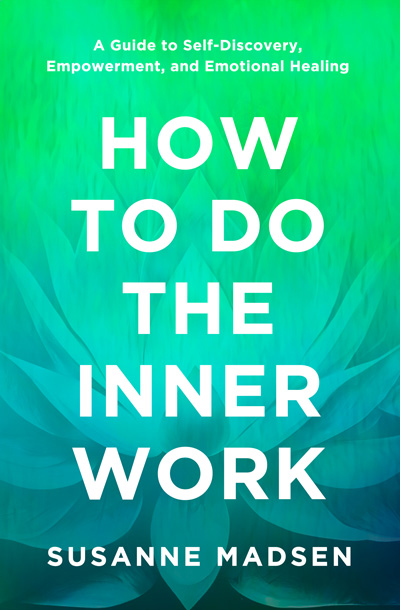
How to Do the Inner Work: A guide to self-discovery, empowerment, and emotional healing, by Susanne Madsen
Review by Donna Andersen
The key to recovery from the sociopath is healing your heart. I’ve said this many times in my blog articles, videos and to my coaching clients. But how do you do it? A new book by Susanne Madsen, How to Do the Inner Work, is a clear, concise guidebook for exactly that.
Sociopaths are evil. They create havoc in our lives. Their behavior is criminal, or it should be. And they often get away with their bad behavior with little to no consequences.
We do our best to fight them, or at least save ourselves. In the end, we usually need to come to terms with our experience and figure out a way to move on in our lives without seeing them get what they deserve. Madsen’s book can help.
Six chapters
Madsen starts by describing the goal of aligning our values and deepest desires with how we actually live our lives.














The book has six chapters:
- Listening to your inner wisdom
- Restoring your energy levels
- Living by your core values
- Using your breath to come home to yourself
- Using meditation to connect to the peacefulness of your heart
- Befriending your challenging thoughts and emotions
Each chapter highlights the issue and describes how it can be addressed. Then Madsen provides simple step-by-step exercises for doing the inner work. Most require only five to 10 minutes. You may want to try them all to find out which work best for you.
The idea is to figure out what you truly want, let go of pain and limiting beliefs (including the mind control created by the sociopath), and then create inner peace.
Using breath to deal with the pain
When we’ve had sociopaths in our lives, we end up with emotional pain and turmoil. But most of us don’t know how to deal with it, so we try to ignore or bury our feelings. In Chapter 4, Madsen writes:
We learn to cut ourselves off from our body to avoid intense feelings. Distracting ourselves with thinking and doing activities is a survival mechanism that helps us cope with the things we find painful. But this way of coping can keep us disconnected from our true selves and stuck in old patterns.
If you’ve spent decades not being fully connected with your body and emotions, you have to understand that it will take a little practice to get back in touch and learn a different way of living. Instead of giving up when it gets hard, you need to give yourself the gift of patience and self-compassion.
Madsen explains how focusing on our breath can bring relief and provides multiple step-by-step exercises on how to do it. They’re simple and effective.
Challenging thoughts and emotions
Perhaps the most helpful chapter is the last one — Befriending challenging thoughts and emotions.
After the sociopath, calling your thoughts and emotions “challenging” is a complete understatement. Despair, grief, betrayal, loss, depression — you’re probably feeling all of them. But Madsen makes a short, simple and profound observation:
No matter how painful or scary an emotional experience is, it will always come to an end.
This is absolutely true, although it may not seem that way when you’re in the midst of it. You try to push your painful emotions out of your awareness by ignoring them, working harder, or perhaps drinking or using substances.
Madsen writes:
We all have patterns like this where we resort to some kind of defense mechanism to protect us from feelings that, in the past, seemed too big and scary to fully feel. But avoiding the negative emotions is not healthy. It is a form of self-rejection, self-denial, and self-sabotage.
Then, she tells you how to change the patterns. Madsen offers an exercise called, Working through challenging emotions, which she calls the most transformational exercise of her book. “The idea is to bring to mind something you have resistance toward and practice exploring and making peace with the emotions that come up for you,” she writes.
Madsen recommends allowing 20 minutes for this exercise. Sit quietly and bring a triggering situation to mind. But don’t stay in your head — allow your body to feel whatever emotions are attached to the experience. Even if it’s difficult, allow the emotion to exist without trying to push it away. If you can do this, it slowly dissipates on its own, and you are free.
Your true recovery
Understanding sociopathic behavior is the first step in your recovery. You can learn about sociopaths here on Lovefraud or through other websites, books and videos. But understanding on an intellectual level what they do and how it affects you is only the first step. True recovery comes from discarding mistaken beliefs and relieving your emotional pain.
Here’s an important truth: You are the only one who can do it. Susan Madsen’s book, How to Do the Inner Work, can help you.
How to Do the Inner Work is available on Amazon.com.
Note: I received a free review copy of the book from the publisher, TCK Publishing.

 Your split brain: Why you still love the abuser