
The fundamental problem with psychopaths is that they do not have the ability to authentically love. I say this all the time in my articles and videos. A reasonable question to ask is why? Why can’t psychopaths love?
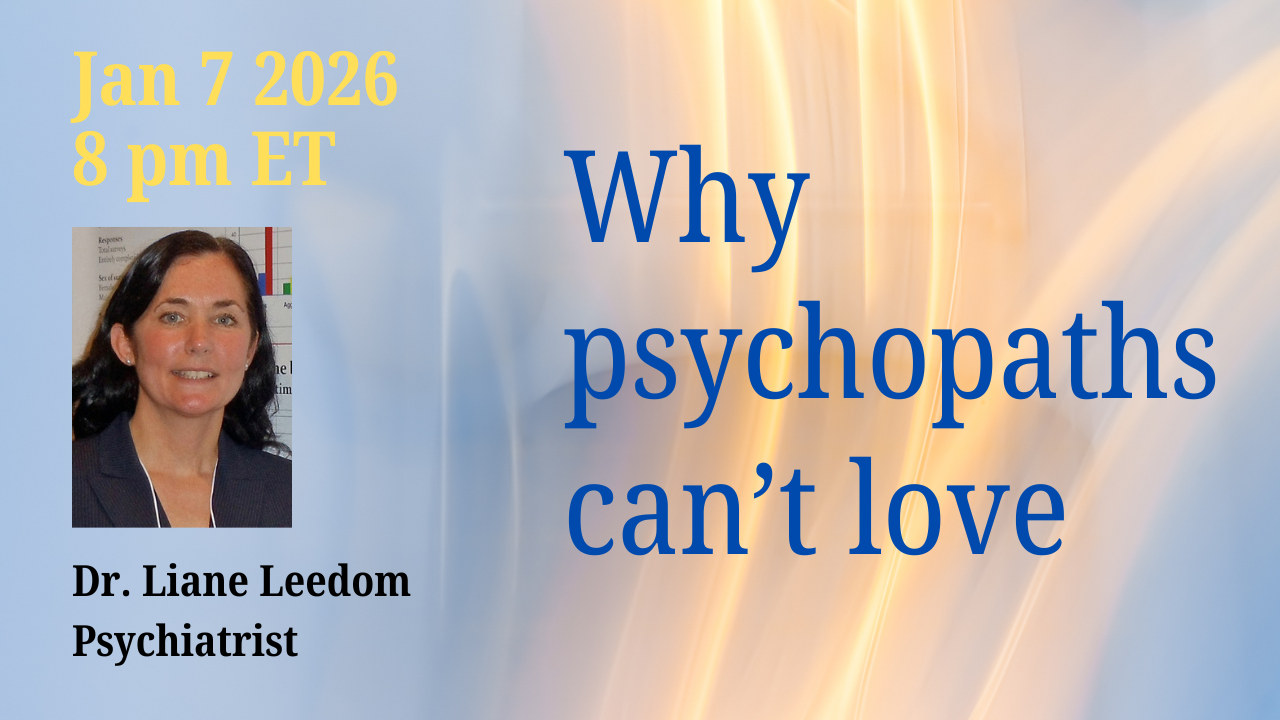
For the answer, we need to look deep into human biology, psychology and even evolution. Luckily, the Lovefraud author Dr. Liane Leedom has done this. She is a psychiatrist and professor of psychology and counseling at the University of Bridgeport. I am interviewing her on Lovefraud Live on Jan. 7, 2026, at 8 pm ET, when she will explain in detail why psychopaths can’t love.
Here are the basics, based on one of Dr. Leedom’s published works called, Psychopathy: A Behavioral Systems Approach.
Four human social behavioral systems
Human beings have four social behavioral systems. The systems evolved over millennia and affect human behavior related to pursuing goals and achieving rewards in interactions with other people. They are:
• Attachment, which is the desire to be with a special person or people. The evolutionary goal is safety through affiliation with other humans.

















• Care-giving, which is the desire to provide protection and support for others, to be concerned about their health and well-being. The evolutionary goal is parental care of young.
• Sex, which is for pleasure, bonding and reproduction. The evolutionary goal is reproduction for the survival of the species.
• Dominance, which motivates individuals to achieve rank, autonomy and privileged access to resources. The evolutionary goal is resource control and interpersonal power.
These behavioral systems are innate, meaning that people are born with them. However, their normal development depends on the experiences people have as they grow and mature.
Love and power motivations
Researchers have identified the first three of the behavioral systems — attachment, care-giving and sex, as components of romantic love.
When you love someone, you want to be with them, you want to take care of them, and in romantic relationships, you want to have sex with them. These drives are all normal.
The dominance drive, or power motivation, is also normal. Because of your power motivation, you want to succeed in life, you want to have a nice house or hot car, you want recognition for your efforts.
In most people, the three love motivations — attachment, care-giving and sex — moderate the dominance motivation. Normal people go after their achievement goals, but without trying to crush others along the way. Their ability to love keeps their pursuit of power in check.
Psychopaths, however, are deficient in their ability to love. With nothing to put on the brakes, their drive for dominance runs rampant and takes over their personalities. Eventually, the only power and control provide the psychopaths with pleasure.
Nature and nurture
How does this happen? The answer is a combination of genetics and upbringing — nature and nurture.
Children may be born with a genetic predisposition to psychopathy. Because the traits are inherited, it usually means one or both of their parents are disordered.
Psychopathic parents have no drive for care-giving and do not provide a nurturing environment for their children. They may be neglectful, critical or downright abusive. Consequently, at-risk children, those with the genetic predisposition to psychopathy, grow up to be disordered themselves.
How does this translate into a psychopath’s inability to love? Dr. Liane Leedom will explain this on Lovefraud Live, Wednesday Jan. 7 at 8 pm ET. Please join us! Sign up to be notified!
Learn more: FREE! Your first step towards real recovery from narcissistic abuse and trauma

 8 attempts to control a sociopath: They all fail