
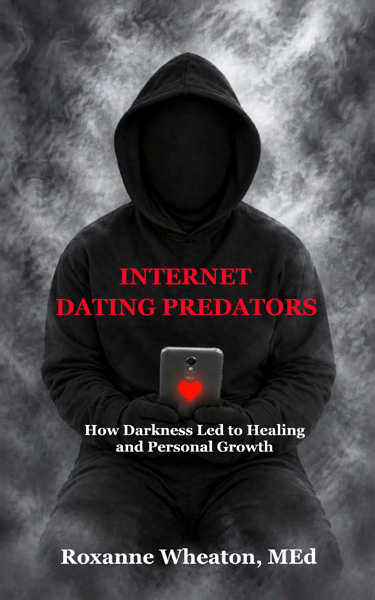
Editor’s Note: With poignant honesty, Roxanne Wheaton tells her tale of being targeted and swindled by a man she met online. Writing her book with the benefit of hindsight, she explains what the predator was really doing as the story unfolds. Roxanne’s insight will help anyone who suspects they may also be dating a con artist to see clearly what is hidden. Her courage will help others escape and recover.
Why I wrote Internet Dating Predators
By Roxanne Wheaton
In 2007, I was completing the final course for my Master of Education degree and looking forward to having more time to enjoy life and reconnect with friends. In my early forties, I also decided to try online dating. That was when I met John. He was charming and attentive, and we had so much in common that our connection felt almost uncanny. I imagined I was stepping into the peaceful, “normal” life I wanted. Instead, I spent the next year trapped on an emotional roller-coaster.










I turned to my journal every day, trying to make sense of what was happening between us. I knew I was no longer being my authentic self, but I could not understand why I was behaving in ways that felt so unlike me.
Within a year, the pieces finally began to fall into place. I realized that John had been manipulating and controlling me. He was a serial predator, and I was caught in an emotional and financial trap. Even after I escaped, I kept journalling, capturing my emotions and the events as they unfolded. I felt compelled to pour everything onto the page. Writing became immediate and visceral—a way to find my footing amid the storm of emotions that followed.
Journalling became a vital part of my healing. Before long, I understood that I needed to write for another reason as well: to raise awareness of internet dating predators and romance scammers. I completed the first draft of this book in 2008–2009. At the time, my research uncovered few resources on the issue. People needed to know that individuals like John exist—that deception is real and often closer than we imagine. The damage reaches far beyond financial loss; victims also carry emotional and psychological wounds that others cannot see. I wanted to help guide them toward healing. I felt a responsibility to become the voice I had once needed.
For several personal reasons, I did not publish the book. As the years passed, I began to believe I had waited too long. Then, by the end of 2025, stories about romance scams were appearing in the news with growing frequency. Year after year, the financial losses climbed, while the reporting rate remained at only 10–20 percent. Yet one crucial part of the story was still being overlooked: the emotional and psychological harm victims endured.
Awareness of romance scams may be growing, but far too many victims still suffer in silence. I could no longer tell myself it was too late. The time had come to publish the book.
That is why I wrote Internet Dating Predators: to give words to experiences that can be difficult to name, to help victims feel seen and understood, and to offer compassionate support as they begin their healing journeys.
I am deeply grateful to Donna Andersen for creating Lovefraud. When I felt isolated and struggled to understand what had happened to me, the “real” stories I found there offered something I desperately needed: the reassurance that I was not alone. Her endorsement of my book is both an honour and a deeply meaningful reminder of how far this journey has carried me.
Internet Dating Predators is available on Amazon.com
Visit Roxanne Wheaton’s website
 Is Elizabeth Holmes intentionally deceptive?