
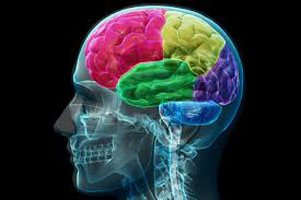
Psychopaths have more than an attitude problem. They are cold, uncaring, manipulative and aggressive due in part to their biology. The overall volume of gray matter in psychopath brains is less than normal. And new research shows that specific areas of their brains associated with skills such as behavior control are smaller.
What does this mean? Psychopathic traits and behaviors are baked into their heads. Changing their behavior means changing their brains, which may not be impossible, but it is certainly incredibly difficult.
Magnificent brain
The human brain is magnificent. It’s what sets us apart from other living creatures.
The outermost layer is called the cerebral cortex, or also gray matter. It has many folds with deep grooves and raised areas. This increases the size of the brain and enables it to process large amounts of information, according to the Cleveland Clinic. The cerebral cortex plays a key role in memory, thinking, learning, reasoning, problem solving, emotions, consciousness and sensory functions.
Scientists have known for years that psychopaths tend to have less gray matter than people who are not disordered. But new research has identified particular areas of the brain, corresponding with particular aspects of psychopathy, that have less volume.
Range of traits and behaviors
Psychopaths routinely violate social norms and cause harm to others, although they are not necessarily serial killers. In fact, many psychopaths aren’t even violent.
This points to a key concept about psychopaths — they aren’t all the same. Psychopathy is both a syndrome and a continuum.
A syndrome means that certain traits and behaviors tend to cluster together in people who have the disorder. A continuum means that any individual can show the traits and behaviors to greater or lesser degrees.

















Therefore, sometimes psychopaths are difficult to spot. They don’t necessarily look like drug dealers or gang bangers. Some are grandiose and charming, and others have poor social skills. In short, some psychopaths are worse than others.
Measuring psychopathy
Back in the 1990s, a psychologist called Robert Hare, Ph.D., developed a way to measure an individual’s level of disorder, called the Psychopathy Checklist Revised. It’s a list of 20 traits and behaviors. When conducting an evaluation, a clinician determines how well each trait describes the individual. The scores are 0, 1, and 2.
- 0 — the person doesn’t show this trait or behavior at all
- 1 — the person sometimes shows the trait or behavior
- 2 — this trait or behavior definitely describes the person
Total scores, therefore, range from 0 to 40. A normal person scores maybe 4 or 5. People who score 30 or above are considered to have severe psychopathic disorders. My ex-husband, who was never violent towards me, scored 39.
Factor 1 and Factor 2
The Hare PCL-R been validated by hundreds of studies. The validation process revealed that psychopathy has two distinct factors. Here are the two factors, and the traits associated with each one:
Factor 1
Interpersonal and affective (emotional) problems. These are considered to be the core features of psychopathy.
- Glibness and Charm
- Grandiosity and Entitlement
- Conning and Manipulative
- Pathological Lying
- Lack of Remorse and Guilt
- Shallow Affect
- Lack of Empathy and Callousness
- Failure to Accept Responsibility
Factor 2
Impulsive and antisocial behavior
- Need for Stimulation
- Impulsivity
- Poor Behavioral Controls
- Irresponsibility
- Parasitic Lifestyle
- Lack of Realistic Goals
- Criminal Versatility
- Violation of Conditional Release
- Juvenile Delinquency
- Early Behavioral Problems
Two other traits of psychopathy
- Sexual Promiscuity
- Short-term Marital Relationships
Correlating brain volume with Factor 1 and Factor 2
The new scientific paper is entitled, Associations of brain structure with psychopathy. Researchers examined MRI brain images of 39 diagnosed psychopaths and compared them to 39 matched controls who were not disordered.
Their hypothesis proposed that the behavioral traits forming the two PCL-R factors involved different sections of the brain. So they looked for correlations between brain structures the psychopaths’ Factor 1 and Factor 2 scores. They found them.
First of all, the researchers found that the psychopathic subjects’ brains were 1.45% smaller, which they termed a “significant volume deficit.”
Read more: Brain Science Part 2: Brains of homicidal juveniles appear to be different
Then, the researchers did find volume deficits in several areas of the brain associated with Factor 2 — antisocial behavior. The affected areas are thought to be relevant for behavior control.
Patterns associated with Factor 1 were less clear-cut. There were only weak associations with disturbances in particular brain regions, which means different individuals have different levels of disturbance.
Because psychopathy is both a syndrome and a continuum, this makes perfect sense. Individual brains are different, and their levels of psychopathic behavior are different.
How psychopathic brains develop
Here is a vastly oversimplified explanation of how psychopathic brains develop. It involves both nature and nurture.
The Lovefraud author Dr. Liane Leedom, a psychiatrist, says that psychopathy is highly genetic. This means children can be born with a predisposition to the disorder. It also means that often, one or both parents are disordered. That’s where the genetic risk comes from.
Psychopaths make terrible parents. They create environmental factors, such as abuse, neglect and harsh parenting, that feed the at-risk child’s disorder. A genetically at-risk child in this environment doesn’t have a chance. He or she can grow up to be disordered.
Changing the brain
Can this be reversed? Can a psychopathic brain unlearn bad behavior and develop empathy, a conscience or the ability to love?
Well, our brains are “plastic,” meaning they can change. But change comes about through desire and practice. Most psychopaths don’t have any desire to change. In fact, many of them are proud of their lack of emotion and conscience. It allows them to go after what they want without guilt.
If they change at all, psychopaths tend to modify the Factor 2 behaviors. They get better at controlling their antisocial behavior, so they’re less impulsive and perhaps better at staying out of jail.
But research shows that the Factor 1 traits — glibness, conning, pathological lying — typically don’t change. In fact, that’s why Factor 1 is considered to be the core of the disorder.
Narcissists and antisocials too
If you think the person you’re involved with is “only a narcissist” and this information doesn’t apply, well, think again.
There is a lot of overlap among these personality disorders, and the diagnostic criteria are not clear-cut. You may think you’re dealing with a narcissist, when the person may actually be antisocial or a psychopath. I’ve heard plenty of people described as “narcissists” when their behavior seemed psychopathic to me.
The bottom line is, anyone with any of these disorders is unlikely to develop a heart and a conscience. Your best bet is to put the person out of your life.
By the way, Dr. Liane Leedom provides an excellent explanation of psychopathic behavior in the free introduction to her Lovefraud recovery skills training series. I recommend you check it out.
Learn more: Your first step towards real recovery from narcissistic abuse and trauma

 Games sociopaths play