
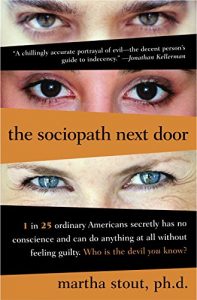
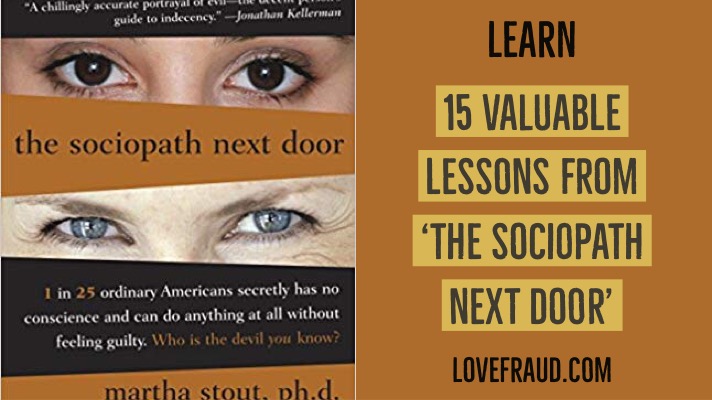
UPDATED FOR 2024. The Sociopath Next Door, by Martha Stout, Ph.D., is a classic for describing sociopathic behavior. I read the book when it was first published in early 2005, shortly before Lovefraud launched. Thirteen years later, I read read it again.
I’ve learned a lot about sociopaths during those 13 years, so the second read was certainly a different experience. The first time I read the book, much of what Stout wrote was a revelation. Here are my observations from the second time around: Stout does a good job of describing sociopathic motivation, but her book fails to capture how dangerous and destructive these people are.
The reason, I believe, is that this was never a book about sociopaths to begin with. It is a book about conscience. Sociopaths are in the book only to illustrate what people do when they have no conscience. My guess is that Stout originally had some other title for the book, perhaps The Importance of Conscience, and her publisher changed the title to make it catchier and sell more books.
Stout illustrates sociopathic behavior by creating stories about four sociopaths based on what patients in her clinical practice have told her, and another story that is complete fiction. It’s an okay approach, in that she’s able to convey what the sociopaths are thinking. But the nasty behavior of her sociopaths is nothing compared to the hair-raising stories posted by Lovefraud readers.
Still, Stout makes many important points related to sociopaths. Here are some that I highlighted:
1 . As a society, we are oblivious to the single most meaningful characteristic that divides the human race: the presence or absence of conscience.











2. What sociopaths want is to control others and win.
3. The difference between normal emotional functioning and sociopathy is almost too fantastic to grasp, so for the most part, we refuse to believe such a hollowness of emotion can exist.
4. The first sociopathic seduction technique is charm, and its power should not be underestimated.
5. Sociopaths study their targets, making it their business to learn how they can be manipulated.
6. Sociopaths have an uncanny sense of who will be vulnerable to sexual overtures.
7. People who do hideous things do not look like people who do hideous things. There is no “face of evil.”
8. The best clue of sociopathic behavior is the pity play, an appeal to your sympathy.
9. Sociopathy is the inability to process emotional experience, including love and caring.
10. Sociopathy is, at its very essence, ice-cold, like a dispassionate game of chess.
11. Sociopaths only feel the “primitive” emotions from immediate physical pain and pleasure, or from short-term frustrations and successes.
12. Narcissists can feel most emotions, but they are missing the ability to understand what other people are feeling.
13. Some theorists propose that North American culture, which values individualism, tends to foster the development of antisocial behavior.
Read more: What’s a sociopath?
14. When considering a new relationship of any kind, practice the Rule of Threes: Three lies means you’re dealing with a liar, and deceit is the linchpin of conscienceless behavior. Cut your losses and get out.
15. If you find yourself pitying someone who consistently hurts you, the chances are close to 100% that you are dealing with a sociopath.
Stout spends about half of the book explaining conscience and its role in our lives. Her basic message is that despite the nagging of our sense of right and wrong, it is better to have a conscience than not have one.
I agree with that, and no matter what we’ve endured because of the sociopaths in our lives, at least we are not them.
The Sociopath Next Door is available on Amazon.com.
Lovefraud originally posted this story on Oct. 29, 2018.
Learn more: Free! The Basics — Love Fraud and how to avoid it
 LETTER TO LOVEFRAUD: She was deceiving both of us and living a double life
regretfullymine
The local library has a hardbound copy of this book. I re-read it so many times I finally bought a copy for myself. Its still a relevant book. Besides the points in your article; the chapter on how to deal with a sociopath is worth the price of the book. (hint, there are 13 things you can do)..Buy this book!